
SW Weekly: The Amazon Squeeze Play - Why a 50% surge in Electrovaya has a catch
Inside the brutal math of supplier warrant deals, navigating a painful Nasdaq pullback, and the $50M micro-cap on my watch list.

Electrovaya shot up 50% during the week on the back of a big order from Amazon. Electrovaya is one of the companies I have traded multiple times, and it has been a great profit maker for us. I have interviewed the CEO several times and hold him in high regard; he, like the rest of his team, is a quality guy. The company has world-leading products and has been growing its market share for several years.
I had said many times that Amazon was its biggest customer, although Electrovaya had never publicly stated it to be so, it was clear from the description they gave, “ A Fortune 100 e Retailer with operations in multiple countries,” that it narrowed it to a field of 1.
The $280 million deal included a large slice of warrants for Amazon; it is a textbook play for Amazon. They have been extracting warrants from smaller suppliers for decades, and analyzing the deals has become a standard question for MBA students. (you can read the question here from 2022) Is the deal a good one? is the usual question, and the answer is, it depends. The deal is always good for Amazon, but not always for the supplier.
First, a word on results
Tech generally is having a poor month, and our small-cap tech stocks are taking a beating. Only 6 of our 25 holdings posted positive results last week. The pullback across the sector has been sharp, prompting me to consider closing some positions to preserve cash. Of course, the last thing I want to do is sell near a price bottom, and with earnings season just getting started, these decisions are incredibly difficult.
The Trade and Invest portfolios lost 7.1% and 7.4% respectively last week, with almost the entirety of those losses hitting us on Thursday, which goes down as the portfolio’s worst single day on record. The Nasdaq 100 fell 4.2% over the week. While a 7.1% drop is painful, it puts our downside beta at roughly 1.7 times the index. Keeping our beta under 2 during a full-blown small-cap tech rout is a decent relative performance on a down week, though it admittedly does little to hide the immediate sting of the loss.
I did not execute any new trades or investments during the week.
Looking ahead, I have one high-conviction stock ready to buy early next week. It is a tight, $50 million market-cap operation that justifies a small bet. The position offers significant potential for outsized rewards. The thesis is supporteed by the proven track record of some heavily invested institutional managers, innovative tech in a high growth area and multiple evaluations. I have mentioned this stock a couple of times (you might remember me describing it as a 6-employee operation a while back, but it has grown a bit since then).
Amazon Supplier Warrants
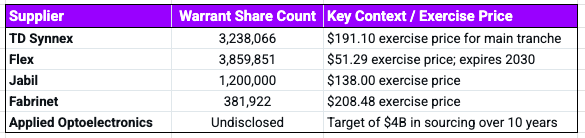
In late 2021, when the Harvard question was first written, Amazon had $3.4 billion in supplier warrants; today, it has moderated to $2.7 billion, but the policy continues.
Recent examples related to AI build include.
It is hard to understand how a big order from Amazon might not be great for any company, but history shows us that companies entering these deals show mixed results for their shareholders. For some, it is the start of great things, for others, it brings no change, and for the rest it is the start of a significant stock decline.
Here are 4 examples (only chosen because I already had the data)

The stocks are universally up in the first few days after the release, but over the next 12 months, the return for shareholders was mixed. PLUG showed a 10% loss that loss is from the pre 70% spike, and it got much worse when they had to report negative equity because of incorrect accounting regarding the warrants. ASTG is the only real gainer; the stock rose 20% immediately and another 20% in the following 12 months to make 40% overall.
The problem is that the warrants must be reported as contra revenue, i.e., they must be deducted from revenue.
I will use the ELVA deal to try to explain this, the impact is different in every case; however, the basic maths and the areas that need looking at are unchanged.
Dilution
Electrovaya has 49.5 million shares outstanding, if Amazon exercised its right to buy all 13.88 million shares it would represent 21.9% dilution for existing shareholders.
It also brings about a hit to earnings per share
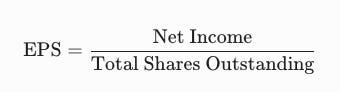
The deal attacks this formula from the top and the bottom, total shares jump by nearly 14 million, and the top line net Income shrinks because of the contra revenue.
Customer Illusion
Amazon was already Electrovaya’s biggest customer, responsible for a big chunk of its revenue. So this deal isn’t tying in a new customer, it is locking in an existing one. A defensive move to stop Amazon from going elsewhere, and they had to give up 21.9% of the company to do it.
Paper v Cash Margin Trap
Here, we have to look at GAAP rules versus cash movement. If a battery costs $60 to make and Amazon pays $100 for it, Electrovaya gets the $100 and takes home $40 in cash to run the business.
The accounting reality is different because of the non-cash warrant charge; Electrovaya has to write off a portion of the $100 revenue on paper. On the GAAP income statement, it might look like they only got $50 in revenue for a battery that cost $60 to make, resulting in a negative net profit margin.
This is exactly what happened to PLUG and CLNE; they generated record amounts of cash, but the earnings report was a disaster because of millions of dollars of revenue being deducted due to the warrants.
Other Issues
Continuing on the margin theme, the guaranteed volumes do allow Electrovaya to spread the cost of its new facility and the manufacturing lines of its recently constructed New York facility over more batteries, helping to keep COGS down.
It has great marketing potential, as now the wider market knows they supply Amazon with batteries for material handling trucks inside its warehouses. That should make it a bit easier to get some new customers.
On the negative side, Electrovaya has two other major customers. Home Depot and Del Monte- you can be certain their buying teams read the Amazon headline and will be using it to negotiate better terms of their own.
The Amazon Squeeze Play
Amazon has mastered the art of the commercial squeeze play. They provide the large volumes needed to justify big capital expenditures, like the New York Electrovaya build-out, but they charge a high price for doing so.
For Electrovaya, the cash flow from the orders is real, and the operational scaling is a long-promised corporate goal. For Amazon, they get the batteries they were going to buy anyway, but stand to make a big profit from the warrants. For the Electrovaya investors, the 12 months following an Amazon announcement can be a sobering reminder of the effect of accounting drag and massive shareholder dilution.
These Deals Last
The four deals I highlighted from 2016 to 2021 with PLUG, CLNE, SPTN and ATSG led to ongoing deep relationships. Plug signed a massive second deal to supply 11,000 tons of liquid Hydrogen. CLNE booked $47 million in ongoing Amazon warrant charges in Q1 2026, and the Spartan deal continues and looks set to cross $8 billion in 2027. Even though it is now private following a $3.1 billion private equity buyout, ATSG remains the foundational operator for the Amazon airfleet.
So the pattern seems to be a short-term pop, 12 months of consolidation flowing into a long-term sticky relationship with Amazon.